
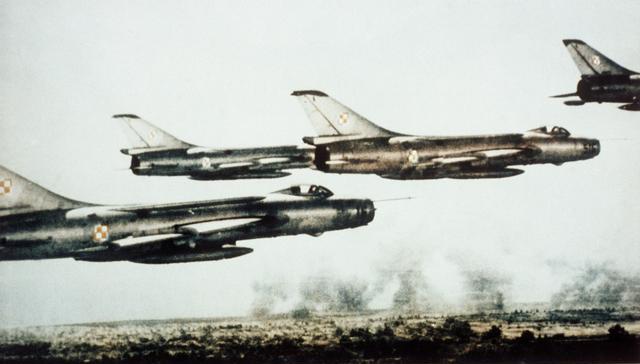
 The Sukhoi Su-7 (NATO designation Fitter-A) was a swept wing, turbojet-powered fighter-bomber used by the Soviet Union and its allies.
Design and development
On 14 May 1953, the Sukhoi OKB was reopened and initially tasked with copying the American F-86 Sabre fighter.By the summer, the OKB began work on a swept-wing tactical fighter for establishing air superiority over the battlefield (frontovoi istrebitel, фронтовой истребитель, front-line fighter in Soviet terminology). The first prototype, designated S-1, was designed to use the new Lyulka AL-7 turbojet and it was the first Soviet aircraft to utilize the all-moving tailplane and a translating centerbody, a movable cone in the air intake for managing airflow to the engine at supersonic speeds.The aircraft also had a dramatic wing sweep of 60°, irreversible hydraulically boosted controls, and an ejection seat of OKB's own design.
The S-1 first flew on 7 September 1955 with A. G. Kochetkov at the controls. Fitted with an afterburning version of the AL-7 engine after the first 11 flights, the prototype set a Soviet speed record of 2170 km/h (1,170 knots, 1,350 mph, Mach 2.04) in April 1956. The prototype was intended to be armed with three 37 mm Nudelman N-37 cannon and 32 spin-stabilized 57 mm (2.25 in) unguided rockets in a ventral tray.The second prototype, S-2, introduced some aerodynamic refinements. Testing was complicated by the unreliable engine and S-1 was lost in a crash on 23 November 1956, killing its pilot I. N. Sokolov. The aircraft entered service as Su-7 in 1959, although it saw only limited operational use.
On 31 July 1958, Soviet tactical aviation (Frontovaya aviatsiya, фронтовая авиация) tasked Sukhoi with developing a ground-attack version of the Su-7. The resulting S-22 retained the basic layout of its S-2 predecessor, incorporating primarily structural refinements for high-speed low-altitude operations. It first flew in March 1959, and began entering service in 1961 as the Su-7B.
A total of 1,847 Su-7 and its variants were built, of which 691 were exported.
Operational history
The Su-7 saw combat with Egypt in the Six Day War in 1967 and the War of Attrition. The Indian Air Force used the Su-7 extensively in the 1971 war with Pakistan. The six Indian Su-7 squadrons flew almost 1500 offensive sorties during the war, and undertook the bulk of the daytime attack efforts. The IAF managed to retain a very high operational tempo with its Su-7's, managing a sortie rate of six per pilot per day. Fourteen Sukhois were lost during the war, but the type had acquitted itself well
Operationally, Su-7s were hampered by high takeoff and landing speeds dictated by the thin, highly-swept wing. The landing speed of 450 km/h (245 knots, 280 mph) combined with poor visibility from the cockpit and lack of an instrument landing system made for difficult operations, especially in poor weather.In 1961-1962, Sukhoi experimented with blown flaps on S-25 but the benefit was too small to warrant implementation. JATO rockets tested on S-22-4 proved more useful and were incorporated into Su-7BKL. Attempts to improve takeoff and landing performance eventually resulted in the Sukhoi Su-17.
Variants
Su-7
First production version, tactical air superiority fighter, factory designation S-2. Manufactured 1957-1960 with 132 built. Remained in operational service until 1965.
Su-7B
Ground attack version, factory designation S-22. Manufactured 1960-1962.
Su-7BM
Upgraded AL-7F-1 engine, upgraded fuel system with external piping on either side of the fuselage spine, fuel tanks installed in the wings, "wet" underwing hardpoints for carrying external fuel tanks, capable of carrying tactical nuclear bombs. Manufactured 1963-1965.
Su-7BKL
Rough-field capable variant with skids affixed to the sides of the main landing gear, provision for two SPRD-110 JATO rockets of 29.4 kN (13,300 lbf) thrust, and twin brake parachutes. Introduced in 1965, factory designation S-22KL. Manufactured 1965-1972.
Su-7BMK
Export version of Su-7BM. Manufactured 1967-1971.
Su-7U (NATO designation
Moujik)
Two-seat trainer version with reduced fuel capacity. First flight 25 October 1965. Manufactured 1966-1972 in parallel with the export version, designated Su-7UMK.
Su-7UM
Two-seat training version of the Su-7BM.
Su-7UMK
Two-seat training version of the Su-7BMK.
Su-7IG
Experimental variable geometry wing aircraft which was developed into Sukhoi Su-17.
100LDU Control Configured Vehicle
A Su-7U modified with canards and a longitudinal stability augmentation system. It was designed as a testbed for a fly-by-wire system for the Sukhoi T-4. It was later used in 1973-1974 during the development of the Su-27's fly-by-wire system.
General characteristics
* Crew: One
* Length: 16.80 m (55 ft 1 in)
* Wingspan: 9.31 m (30 ft 7 in)
* Height: 4.99 m (16 ft 4 in)
* Wing area: 34 m² (366 ft²)
* Empty weight: 8330 kg (18,365 lb)
* Loaded weight: 13570 kg (29,915)
* Max takeoff weight: 15210 kg (33,530 lb)
* Powerplant: 1× Lyulka AL-7F-1 afterburning turbojet
o Dry thrust: 66.6 kN (14,980 lbf)
o Thrust with afterburner: 94.1 kN (22,150 lbf)
* *Fuel capacity: 3220 kg (7,100 lb)
Performance
* Maximum speed: 1,150 km/h (620 kn, 715 mph, Mach 0.94) at sea level; 2150 km/h (1,160 kn, 1,335 mph) at high altitude
* Range: 1,650 km (890 NM, 1,025 mi)
* Service ceiling 17600 m (57,740 ft)
* Rate of climb: 160 m/s (31,500 ft/min)
* Wing loading: 434.8 kg/m² (89.05 lb/ft²)
* Thrust/weight: 0.71
* Takeoff roll: 950 m (3,120 ft)
* Landing roll: 700 m (2,300 ft)
Armament
* 2× 30 mm Nudelman-Rikhter NR-30 cannon, 80 rounds each
* Up to 2000 kg (4,410 lb) on six hardpoints, typically including two 600 l (160 US gal) fuel tanks under the fuselage, and a combination of 250 kg (550 lb) or 500 kg (1,100 lb) bombs and 57-mm spin-stabilized unguided rockets in UB-16-57U pods. A 8U69 5-kiloton nuclear bomb could be carried on the left fuselage hardpoint.
Saturday, December 20, 2008
Labels: Fighter Plane, history |
Subscribe to:
Post Comments (Atom)


0 comments:
Post a Comment